Cestian · Guides
Choosing a Travel Kit for Children: Calm, Organisation and Suitable Entertainment
A travel kit for children brings together items that are regularly needed on the move: something to play with, a familiar object and, where appropriate, supplies for meals or personal care. The best combination depends less on the number of items than on the journey itself. A short train journey requires different supplies from a long flight or car journey.
Start by deciding which problem the kit should address: boredom, misplaced belongings or difficult care routines. A compact kit with familiar, useful items often works better than a full bag containing many surprises. Also consider who will carry the kit and how much help your child will need to open it, put things away and use its contents.
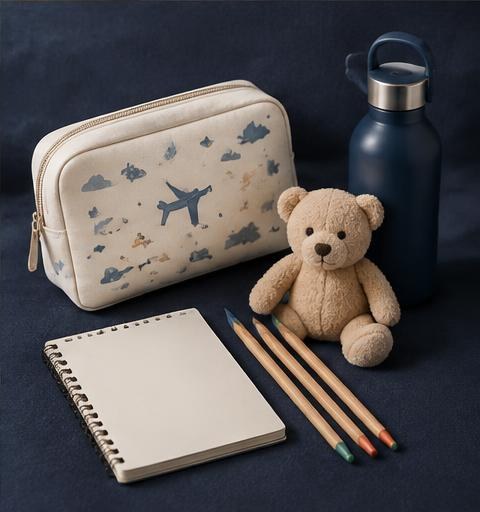
What Should You Consider When Choosing a Children's Travel Kit?
Age suitability and safety take priority over completeness. Check the age recommendation for every item and assess whether it suits your child's stage of development. Avoid small loose parts and button batteries for young children; also watch for parts that could come loose. Check fastenings, cords and the security of attachments. Adult supervision remains necessary during use, especially when eating or doing crafts. A travel kit or comfort accessory never replaces an approved child restraint system and must not interfere with its operation.
Choose the size and layout according to the available space. Measure to check whether the bag can be kept within reach without blocking an aisle or passageway. Wide openings, clearly organised compartments and easy-to-grip zip pulls help children find things independently. Have your child carry the filled kit briefly: an empty bag tells you little about carrying comfort. There are no universal cabin baggage dimensions for air travel. Check the requirements of each operating airline and the fare you have booked; measure including wheels and handles, and weigh the fully packed luggage.
Assess the contents for reusability and ease of cleaning. Choose wipe-clean surfaces or washable covers, and check that containers close securely. Keep food separate from care products, and check ingredients and materials if there are known allergies. Alternate quiet activities, such as drawing, looking at pictures and listening. Download digital content in advance and check offline access and the rules for devices on board. Noise cancellation is not hearing protection: keep the volume moderate, take listening breaks and ensure that your child remains aware of their surroundings.
Four Types of Travel Kits for Children
1.Compact Activity Travel Kit
This category focuses on activities such as drawing, reusable activity tasks and simple play materials. Choose activities that fit on a lap or a small table. Keeping loose parts to a minimum reduces the need to search between seats. Match the difficulty to what your child can manage independently; an unfamiliar task may actually require extra guidance while travelling.
- Pros:
- a lightweight activity kit offers variety without taking up much luggage space.
- Cons:
- attention may fade quickly if all the activities are similar.
2.Backpack Kit with Organised Contents
A children's backpack with matching cases or storage pouches provides designated places for toys, an extra item of clothing and personal belongings. Look for adjustable straps, a suitably sized back panel and a clearly organised layout. Pack frequently used items at the top and keep the weight down so that carrying it independently remains manageable after setting off.
- Pros:
- your child can recognise their own belongings, carry them and find them more easily.
- Cons:
- having many compartments does not automatically make a small backpack easier to keep organised.
3.Mealtime and Personal Care Travel Kit
Here, the emphasis is on drinking and eating supplies, wipes and space for clean or used clothing. Choose items that are easy to clean and a separate compartment for damp belongings. Check what options are available during the journey for storing food appropriately; an ordinary storage compartment will not, by itself, keep perishable food sufficiently cool.
- Pros:
- everyday care routines require less searching through different bags.
- Cons:
- leaks and used items require careful separation and regular cleaning.
4.Comfort Kit for Rest Breaks
A comfort kit might contain a familiar soft toy, a lightweight blanket or a suitable small pillow for older children. Choose according to the temperature, available seating space and washability. When considering accessories for child car seats, consult the seat manufacturer's instructions first; do not add anything that changes the belt routing or fit.
- Pros:
- familiar materials can help support a calm transition to a rest break.
- Cons:
- soft items take up relatively large amounts of space and do not guarantee sleep.
A well-considered children's travel kit starts with your journey and your child, not a long list of contents. Choose one main purpose, add only essential extras and try out the packed kit at home. This will show you which items are useful, what is missing and what can safely be left at home.
Frequently Asked Questions About Children's Travel Kits
Is a complete kit better than putting one together yourself?
Not necessarily. A complete kit saves time spent selecting items; putting one together yourself avoids unnecessary contents and often fits better with existing favourites.
How many toys should you take?
Choose a few different activities and offer them in turn. Keep one alternative aside for delays or an unexpectedly long wait.
Where should you pack a power bank for a tablet?
Power banks and spare lithium batteries belong in cabin baggage, with their terminals protected. Check the airline's current rules and do not take damaged or swollen batteries.
Some links on this page are partner links. If you buy through such a link, Cestian receives a small reward from the seller. The price you pay does not change.