Cestian · Guides
Hand Luggage and Carry-On Suitcases: Choosing by Size, Weight and Use
A good carry-on suitcase fits not only in an overhead compartment, but also with the way you travel. For a short business trip, organisation matters; on a city break, ease of getting around on foot and a low empty weight often matter more. Travellers who pack light also quickly notice how much difference an easily accessible layout makes.
Start, therefore, not with the colour or the number of compartments, but with your usual routes and modes of transport. Will you need to climb many stairs, walk over cobblestones or make connections? Will you mainly be carrying clothing, or also a laptop and documents? This guide from Cestian helps you weigh up the practical considerations.
What Should You Look for When Choosing Hand Luggage?
Dimensions and permitted weight are the first selection criteria. There is no universal hand luggage size: before every flight, check both the operating airline's rules and the fare you have booked. A small bag that fits under the seat is not the same as a wheeled suitcase permitted in the overhead compartment. Always measure the external dimensions, including wheels, handles and protruding pockets. Weigh the bag fully packed and leave some allowance for purchases along the way. An expandable suitcase may exceed the permitted dimensions once its expansion zip is opened.
Next, assess how comfortable the luggage is to carry and wheel. Four swivel wheels roll easily alongside you on a smooth terminal floor; two larger wheels are often easier to use on uneven paving, depending on their design. Check that the telescopic handle locks at a comfortable height and does not wobble excessively. A sturdy top handle and side handle help with lifting. Also consider the empty weight: a lightweight suitcase leaves more allowance within the weight limit, but thin materials and basic components may be less durable.
Finally, consider the layout, fastenings and maintenance options. A front pocket is useful for items you need while travelling; a case that opens into two halves keeps contents organised, but requires more floor space when opened. Check that the zips run smoothly and that the lining is accessible for cleaning. Ask about replaceable wheels and warranty terms. Spare lithium batteries and power banks must be carried in cabin baggage, with their terminals protected. Check the airline's current rules and do not bring damaged or swollen batteries or power banks. Keep these items easy to remove in case your suitcase has to go in the hold after all.
Four Types of Hand Luggage and Their Trade-Offs
1.Hard-Shell Carry-On Suitcase
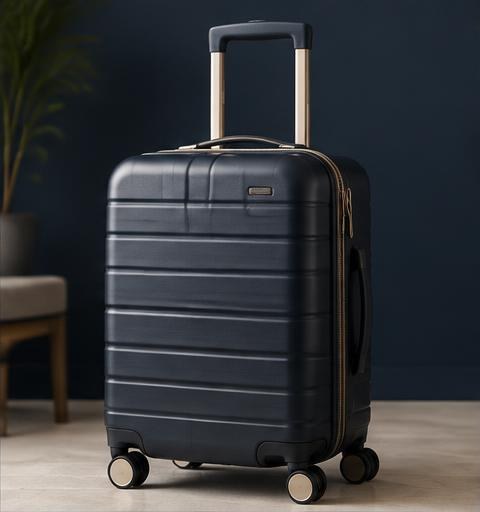
A hard-shell suitcase gives your luggage structure and is suitable if you want to keep your clothing organised. Pay attention to the flexibility of the shell, the quality of the corners and the space taken up by the wheel housings. Fragile items still require separate protection inside this type of case. A hard exterior does not automatically make a suitcase waterproof.
- Pros:
- the rigid shape protects against light pressure, and the exterior is generally easy to wipe clean.
- Cons:
- the shell has little give, and visible scratches are difficult to avoid.
2.Soft-Sided Wheeled Cabin Suitcase
A soft-sided wheeled suitcase suits travellers who like to be able to reach documents or a cardigan while on the move. Compare the positioning of external pockets and check whether a filled front pocket throws the suitcase off balance. Fabric may give slightly when packing, but this is not a licence to exceed the permitted external dimensions.
- Pros:
- external pockets provide quick access, and some models open without unfolding two equal halves.
- Cons:
- fabric picks up dirt more easily and generally offers less protection against compression.
3.Travel Backpack as Hand Luggage
A travel backpack is practical for stairs, public transport and uneven ground. Choose adjustable shoulder straps and check the fit with a representative load. An opening that extends around the bag makes packing more organised than a top opening alone. Also check whether loose straps can be tucked away so that they are less likely to catch on something.
- Pros:
- your hands remain free, and you do not need to pull your luggage over obstacles.
- Cons:
- your body carries the entire weight, and soft sides offer limited protection for fragile contents.
4.Compact Travel Bag or Weekend Bag
A compact travel bag is suitable for a lightly packed overnight stay or a minimalist weekend trip. Look for a wide opening, a reinforced base and comfortable handles. A shoulder strap helps over short distances; try the bag when filled to check that it does not hang awkwardly against your leg. Always compare the stated dimensions with the bag's actual shape when packed.
- Pros:
- the simple layout is flexible, and an empty bag can often be stored compactly.
- Cons:
- carrying the bag on one side for a long time can be uncomfortable, and small items are more easily misplaced without organisers.
The best choice depends on your route, packing habits and preferred way of carrying your luggage. Check the transport rules first, then compare empty weights and try the handles, wheels or shoulder straps. Choose a suitably sized, well-organised bag rather than extra capacity you are not allowed to take with you. This keeps your hand luggage manageable, including during connections and the final stretch to your accommodation.
Frequently Asked Questions About Hand Luggage
Does every carry-on fit in the overhead compartment?
No. The carry-on designation does not guarantee acceptance. Check the operating airline's rules, your fare and the full external dimensions.
May I bring a laptop in a separate small bag?
That depends on your baggage allowance. Sometimes a laptop bag counts as your only permitted personal item.
What should you check again before departure?
Measure and weigh your packed luggage. Also check the current rules for liquids, electronics and batteries.
Some links on this page are partner links. If you buy through such a link, Cestian receives a small reward from the seller. The price you pay does not change.